
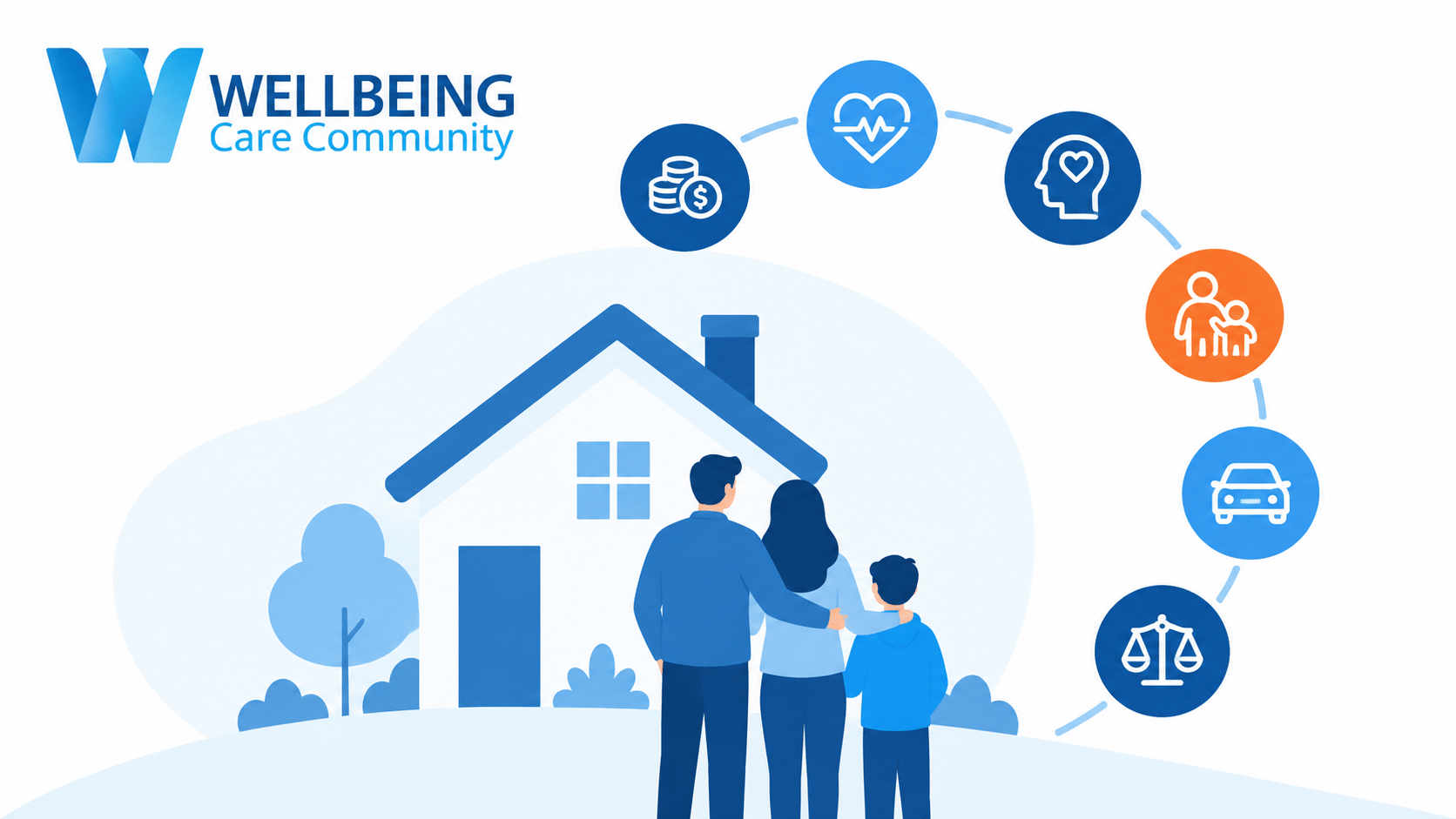
A lease is the visible part of housing stability. What supports that lease is everything around it: income, healthcare, behavioral health, childcare, transportation, and legal help, all arriving in time and staying connected as a household’s situation changes.
What Goes Into Achieving Stable Housing?
Housing stability is a household’s ability to stay in safe, affordable housing over time without repeated crisis, forced moves, or returns to shelter. It is supported by a set of services working together, not by any single program.
For most households at risk, four things have to line up at once:
- Enough income, or enough help with the gap. Employment support, benefits enrollment, rental assistance, and utility assistance.
- Health and behavioral health that stay reachable. A missed refill, an untreated condition, or a recovery setback can end a tenancy faster than a rent increase.
- The practical supports that make daily life work. Transportation, childcare, food, and identification documents.
- Ongoing relationships and consistent, coordinated follow-up. Housing loss rarely happens on the day of intake. It usually happens later, after an immediate referral is closed and other life events happen.
The first three are usually delivered by different community organizations, funded by different sources, and recorded in different systems. That is the part communities have the least tooling for, and it is the part that decides whether the fourth one is possible.
Why Placement Is Not the Same as Stability
Communities have made real progress on the visible side of homelessness response. Shelter capacity, rapid rehousing, and coordinated entry systems are maturing, and moving a household from the street or shelter into permanent housing is getting faster.
Progress has been slower for households whose needs span multiple systems. Picture someone managing a chronic health condition, a behavioral health need, an eviction filing, and a pending benefits application. That person is likely working with four disconnected organizations at once. If it happens at all, the coordination between those organizations usually happens through a phone call or email between staff members who happen to know each other. Rarely is there an accountable, shared system connecting these partners.
These are the households most likely to return to homelessness. When a placement fails, the cause is rarely the housing program itself. More often, a referral was never completed, a prescription lapsed, a court date passed without support, or a benefits application stalled at another agency.
Housing programs are measured on placements because placements are easy to count. The factors that decide whether a placement lasts sit between organizations, where no one owns the record and no report tracks the long-term outcomes.
Where the Connections Break
Most housing programs already know which services a household needs. The breakdown happens between knowing and confirming. Five points account for most of it:
- The referral is made, but not completed and confirmed. A case manager sends a household to a behavioral health provider or a legal aid clinic and has no way to see whether the appointment happened. The referral is recorded as made, which is not the same as connected.
- The same story gets told five times. Each partner runs its own intake. A household in crisis repeats its history at every door, and each retelling is a chance to disengage.
- Records do not agree on who the person is. The same household appears as three different records across housing, health, and food assistance, so no one sees the full picture.
- Health and behavioral health sit on opposite sides of a legal wall. Sharing that data across organizations is lawful with the right agreements and safeguards, but most communities don’t have the infrastructure required to properly safeguard and manage such a system.
- The file is closed when the placement is made. Funding and support often end at the lease signing, so the months when a tenancy is most fragile are often the months with the least visibility.
None of these are staff performance problems. They are what happens when a support model runs on tooling that was only built for single-agency reporting.
What a Connected Housing Stability System Does
A housing stability platform is software that lets multiple organizations screen, refer, coordinate, and track services for the same household in one shared record, with confirmation that each referral connected. Seven capabilities in Wellbeing Care Community separate that from a referral directory:
- One shared record per household. Housing, health, behavioral health, employment, nutrition, and legal partners see the same person rather than six unlinked cases, with role-based rules controlling what each team member can view.
- Common intake with partner-specific layers. Coalition partners agree on shared assessments, then they can add their own organization-specific screenings.
- Closed-loop referrals. A referral carries a status through to confirmation, so a coordinator can answer whether the person arrived, not just whether the referral was sent.
- Personalized success pathways. Goals, steps, interventions, metrics, and assigned care team members, built from reusable, adjustable evidence-based templates so everyone gets the best plan and support.
- Improved client engagement. A client mobile app and portal, plus texting within WCC, are included, so contact isn’t limited to the voicemail phone-tag that is so common with many systems.
- A resource directory the household can use directly. Through myWellbeingDirectory, a person can look up help and start their own referral without needing an agency to open the door first.
- Outcome and funder reporting from the same data. Customizable dashboards show services delivered and life outcomes changed, with data exportable for reimbursement, grant reporting, and Continuum of Care requirements.
Coordination Without Replacing What Partners Already Have
Most cross-agency technology conversations end with the same reasonable objection. Every partner already has a system, many of those contracts aren’t the coalition’s to cancel, and nobody wants a migration in the middle of a funding cycle.
A successful model has to add to what already exists. Wellbeing Care Community can connect with the tools partners already use, including 211, community resource directories, HMIS, and EHR systems. A housing agency can keep its HMIS reporting, and a clinic keeps its EHR. What they gain is a shared place where the work between them happens.
- No wrong door. A household can start at a food pantry, a church, a reentry program, or a clinic and still reach housing support. For example, a local food bank can post a QR code in its pantry line so people can screen themselves on their own phones for help with utilities, medical care, transportation, childcare, and housing.
- Adoption is a sequence, not a launch. Coalitions usually start with two or three partners focused on one population. Once they’ve shown that referrals close, they add partners as the shared record earns trust.
Who This Is For
- Continuums of Care and coordinated entry leads who need visibility across partners that HMIS doesn’t provide.
- Eviction prevention and housing stability programs, where one missed connection can cost a household its tenancy.
- County and city health and human services agencies coordinating housing with behavioral health, benefits, and justice-involved reentry.
- Community-based organizations and coalition anchors that need a shared operating layer, often acting as a Community Care Hub.
- Health systems and managed care organizations where housing drives cost and readmissions.
Frequently Asked Questions
What Is a Closed-Loop Referral?
It’s a referral where the sending organization learns whether the person actually connected with the service. Open-loop referrals are just information handed out with no accountability for completion of service, which is why many look complete in reports while needs remain unmet in real life.
Can Housing and Health Partners Coordinate Legally?
Yes, with proper consent, agreements, and safeguards. Behavioral health and substance use records are covered by 42 CFR Part 2, which adds protections beyond HIPAA, so any platform needs to support those rules directly.
Does a Coalition Have to Replace Its Existing Systems to Use WCC?
No. While WCC is robust and able to be the primary operational platform for community partners, agencies can also keep their own existing tools and gain a shared coordination suite with WCC.
How Do Communities Show Funders That Coordination Worked?
They report from the coordination data itself: services delivered, referrals confirmed, and outcomes over time. That data can be exported for reimbursement, grant applications, and Continuum of Care reporting.
Ready to Take the Next Step for Your Community?
Contact eTransX today to discuss how Wellbeing Care Community can help your partners close the loop on housing stability.
Learn more on the Housing Stability page,Contact eTransX or call 888-221-4971.