
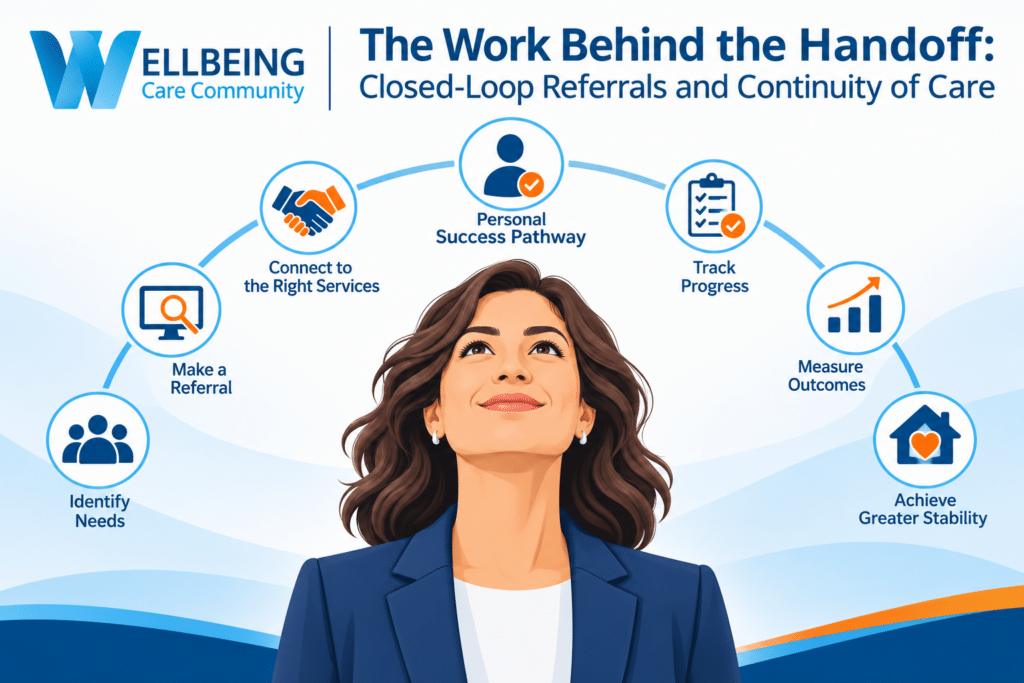
See How Wellbeing Care Community Supports Better Care Coordination
Client needs rarely fall through the cracks because a service wasn't available. They fall through when they're passed from one caseworker to another, or from one agency to another, and the important details don't come with them. The new caseworker doesn't know what's already been tried, what referrals are still open, or what the client was told last week. So the client has to start over, and many of them simply don't.
What Gets Lost When a Client Changes Hands
Clients frequently move between community providers. A caseworker leaves, a client moves to a new program, or a partner agency takes over part of the work. For the next person to pick up where the last one left off, they need four things:
- The client's history. Who the client and their family are, what has already been tried, and what each partner is working on right now.
- The plan. The client's goals, the steps to reach them, and who is responsible for each step. Not just a list of services delivered.
- Open referrals and their status. Where the client was referred, to whom, and whether they ever got help.
- Every conversation. Calls, texts, emails, and visits, including the ones that went unanswered.
In most communities, this information is spread across three or four different systems, plus someone's email inbox and personal cell phone. Very few communities have a good way to pull it together. That gap is where referrals succeed or fail, and where clients get lost.
Sending a Referral Is Not the Same as Getting Someone Help
Most organizations can tell you how many referrals they sent last quarter. Far fewer can tell you how many of those clients actually received the service.
This matters most when a client changes hands. In a report, a referral marked "sent" looks exactly the same whether the client was seen the next week or never picked up the phone. The new caseworker can see that a referral went out, but has no idea whether it worked.
Take a family working with a housing program, a behavioral health provider, a benefits office, and a food pantry at the same time. That's four intake forms, four separate records, and four sets of notes. When their caseworker leaves, the only person who understood how all four pieces fit together is gone.
These are the clients most likely to stall. Not because help wasn't available, but because no one can see, in one place, what has already been done for them.
Where Things Break Down
Most programs already know what a client needs. The problem is confirming that the client actually got it. Five issues cause most of the trouble:
- Referrals are sent but never confirmed. A caseworker refers a family to a partner agency and has no way to know if the appointment happened. The system shows the referral went out. It doesn't show whether the family ever got there.
- The client's history lives in one person's head. When that caseworker leaves, everything they knew about the family leaves with them, and the next person starts from scratch.
- Staff text clients from their personal phones. Those messages never make it into the client record. Program managers can't see them, and neither can the next caseworker.
- Every partner does its own intake. The client has to tell their story again at every agency. Each time they repeat it is another chance for them to give up.
- Reports are pieced together at the end of the month. Staff fill the gaps with spreadsheets and sticky notes because their systems don't talk to each other, and no one has the full picture.
None of these are staff performance problems. They happen because most case management tools were built for a single agency, not for several agencies working with the same client.
How Wellbeing Care Community Keeps the Whole Picture in One Place
A care coordination platform gives every partner working with a client the same record, the same plan, and the same communication history. Every referral is tracked until the client actually gets help. Wellbeing Care Community (WCC) does this with six core features:
- One record for each client and family. Every approved partner can add to it and see it. Role-based permissions control exactly who sees what, and full consent management means information is only shared when it should be.
- A personal success plan, not just a case to close. Each client gets a long-term pathway with goals, steps, and an assigned owner for each step across their whole support team. Templates let agencies start from proven, evidence-based approaches and adjust from there.
- Assessments that point to the next step. Agencies can build their own assessments or use standard ones, including screening for health-related social needs. Scores are calculated automatically and can trigger the next action without anyone having to remember to do it.
- Closed-loop referrals. Caseworkers refer clients directly to partner agencies in the network and can see if and when the need was met. No more sending a referral and hoping for the best.
- Every conversation stays in the record. Clients get a mobile app (iPhone and Android) and a web portal where they can see their plan and appointments and contact their support team. Caseworkers can text clients from inside the platform, either individually or using approved templates, so no one has to use a personal phone. Emails and video visits are saved the same way.
- Reports that don't have to be built by hand. Supervisors see caseloads, client engagement, and progress on each client's plan in a live dashboard, instead of asking staff to fill out reports at the end of the month. Those reports are only as good as the data behind them, which is one more reason the record and the daily work belong in the same system.
Clients can also bring the people who support them into the platform. Family members, friends, a sponsor, or a mentor can be part of their support team, under the same permissions as everyone else.
Works With the Systems Partners Already Use
Partners don't have to give up their current systems. WCC connects with HMIS, electronic health records, 211, and community resource directories like myWellbeingDirectory. The HEMI integration engine handles the data exchange behind the scenes. If staff are still typing the same information into multiple partner portals, XRunner lets them enter it once. Coalitions get one shared place to coordinate care without forcing every partner through a system migration.
Who This Is For
- Care coordination and case management teams where clients regularly move between caseworkers.
- Coalitions and Community Care Hubs where several partner agencies serve the same families, and where good intentions alone aren't enough to make the partnership work.
- Behavioral health and substance use programs, where a person-centered approach to mental health services depends on consistent support between visits.
- Housing stability, reentry, and workforce programs whose results depend on partners they don't control.
- County and city health and human services agencies measured on outcomes, not referral counts.
- Program managers who have no easy way to see what their team promised a client last week.
Frequently Asked Questions
What is a warm handoff in care coordination?
A warm handoff is when a caseworker introduces a client to the next caseworker or provider while all three are present, whether in person, by phone, or on a video call. It helps build trust, but it isn't enough on its own. If the client's history, plan, and open referrals aren't shared too, the new caseworker still has to piece everything together from scratch.
What happens to a client's information when a caseworker leaves?
With WCC, it stays in the client's record. The history, the plan, the referrals, and every conversation are saved in one shared record instead of in one person's notes and phone. The next caseworker can pick up right where the last one left off.
Why is texting clients from a personal phone a problem?
Those messages never make it into the client's record. Program managers can't see them, the next caseworker can't see them, and when that caseworker leaves, the conversation leaves with them. Texting from inside WCC, either individually or with approved templates, keeps every message in the client's record and keeps staff phone numbers private.
Can clients see their own plan and message their team?
Yes. Clients get a mobile app (iPhone and Android) and a web portal where they can see their plan and appointments and contact their support team directly. Family members, a sponsor, or a mentor can be included too, under the same permissions as everyone else.
Is a care coordination platform the same as a referral management system?
No. A referral management system sends a request from one organization to another. A care coordination platform tracks the client's whole journey over time, including the shared record, the plan, assessments, every conversation, and referrals. The difference shows up when a client changes hands. A referral log can tell the new caseworker what was sent, but not what was learned along the way.
Ready to Take the Next Step for Your Community?
Less time chasing information. More time helping people succeed.
Contact eTransX to talk about how Wellbeing Care Community can help your partners stop losing clients between referrals.
Learn more on theWellbeing Care Community page, see how other communities are using it in our testimonials and case studies, or call888-221-4971.