
Choosing a Healthcare Integration Platform That Handles FHIR and HL7 v2 — Without Painting Yourself into a Corner
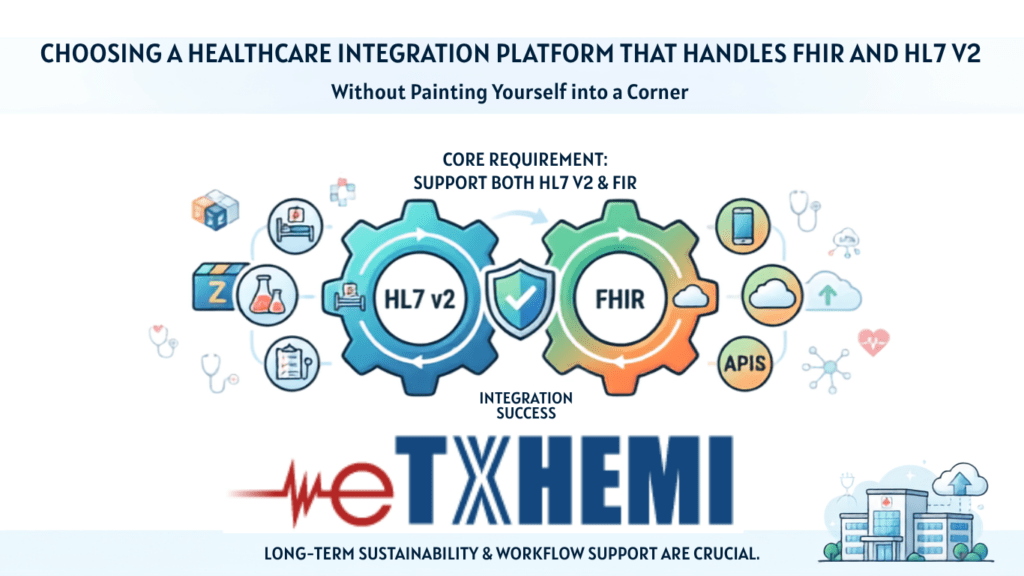
Selecting a healthcare integration platform is one of the most important technology decisions an organization can make. The right choice can support interoperability goals for years. The wrong choice can lead to expensive migrations, complex workarounds, and ongoing operational challenges.
Many healthcare organizations find themselves replacing integration platforms after only a few years because the solution they selected could not keep up with changing interoperability requirements.
Today, one of the biggest considerations is finding a platform that can effectively support both HL7 v2 and FHIR.
Why Healthcare Organizations Need Both HL7 and FHIR
There is a common belief that healthcare is gradually moving away from HL7 and fully adopting FHIR. In reality, most organizations will be working with both standards for many years.
HL7 v2 remains deeply integrated into healthcare operations. It is widely used for:
-
- ADT notifications
- Laboratory results
- Radiology communications
- Billing workflows
- EHR integrations
At the same time, FHIR is becoming more popular for modern interoperability initiatives, including:
-
- Patient access APIs
- Payer-provider data exchange
- Prior authorization workflows
- Value-based care programs
- Care coordination initiatives
Because both standards play important roles, healthcare organizations need integration platforms that can support them equally well.
Key Questions to Ask During Vendor Evaluations
When evaluating healthcare integration platforms, asking the right questions can help you avoid future problems.
How Does the Platform Handle HL7 Customizations?
Real-world HL7 environments rarely follow a perfect standard.
Most healthcare organizations use custom fields and Z-segments that have been added over time to support unique workflows.
A strong integration platform should make it easy to manage these customizations without requiring extensive custom coding.
Look for features such as:
-
- Configurable schema management
- Reusable message profiles
- Support for custom segments
- Prebuilt configurations for major EHR systems
These capabilities can significantly reduce implementation time and maintenance effort.
Does the Platform Create Vendor Lock-In?
Many integration platforms use proprietary mapping tools and scripting languages.
While these tools may simplify initial development, they can create challenges later if your organization needs to audit, migrate, or expand integrations.
Whenever possible, look for platforms that support open standards and exportable transformation logic.
This helps ensure that your organization maintains control over its integration assets.
How Are Errors Managed?
Healthcare data exchange requires reliability.
Failed messages can affect patient care, care coordination, and operational workflows.
A strong platform should provide:
-
- Real-time monitoring
- Automated alerts
- Detailed error reporting
- Message retry capabilities
- Audit logging
Your team should be able to identify and resolve issues quickly before they impact users.
Does the Platform Understand Healthcare Workflows?
Moving data from one system to another is only part of the challenge.
Healthcare organizations increasingly need support for:
-
- Care coordination
- Closed-loop referrals
- Population health programs
- Social Determinants of Health initiatives
- Community-based care programs
Platforms that understand healthcare workflows can help organizations achieve better outcomes while reducing implementation complexity.
Can the Vendor Demonstrate Real-World Success?
Product demonstrations are useful, but production experience matters even more.
Organizations operating across health systems, payer networks, HIEs, or community care programs often provide valuable insights into how a platform performs under real-world conditions.
Warning Signs to Watch For
During the evaluation process, some responses should prompt additional questions.
Be cautious if you hear statements such as:
-
- "FHIR support is coming soon."
- "FHIR is available through a partner solution."
- "Our proprietary scripting language is better than industry standards."
- "Pricing is based entirely on message volume."
These answers may indicate future limitations, higher costs, or additional complexity.
What Long-Term Interoperability Looks Like
The best integration platforms are designed to evolve alongside healthcare standards.
They support both HL7 v2 and FHIR as core capabilities, provide flexibility for customization, and offer clear upgrade paths as standards continue to change.
They also help organizations manage the growing demand for care coordination, referral management, patient engagement, and population health initiatives.
When evaluating solutions, focus on long-term sustainability rather than short-term convenience.
Final Thoughts
Choosing a healthcare integration platform is not just about meeting today's requirements. It is about ensuring your organization can adapt to future interoperability demands without rebuilding its entire integration environment.
Before deciding, evaluate how well a platform supports both HL7 and FHIR, how it handles customization, how it manages errors, and whether it can grow with your organization's needs.
The organizations that avoid costly platform replacements are usually the ones that ask these questions before signing a contract, not after implementation begins.
A thoughtful evaluation process today can save years of complexity and expenses in the future.
Discover how a platform built for both HL7 v2 and FHIR can simplify interoperability, reduce implementation time, and scale with your organization's evolving needs.
https://calendly.com/etransxsolutions/lets-connect-to-discuss-needs
HEMI by eTransX
HEMI is the eTransX healthcare integration engine built to run HL7 v2, HL7 v3, and FHIR side by side, so adopting a new standard does not mean rebuilding what already works.