
Health-Related Social Needs (HRSNs): What They Are and Why They Matter in Connected Care
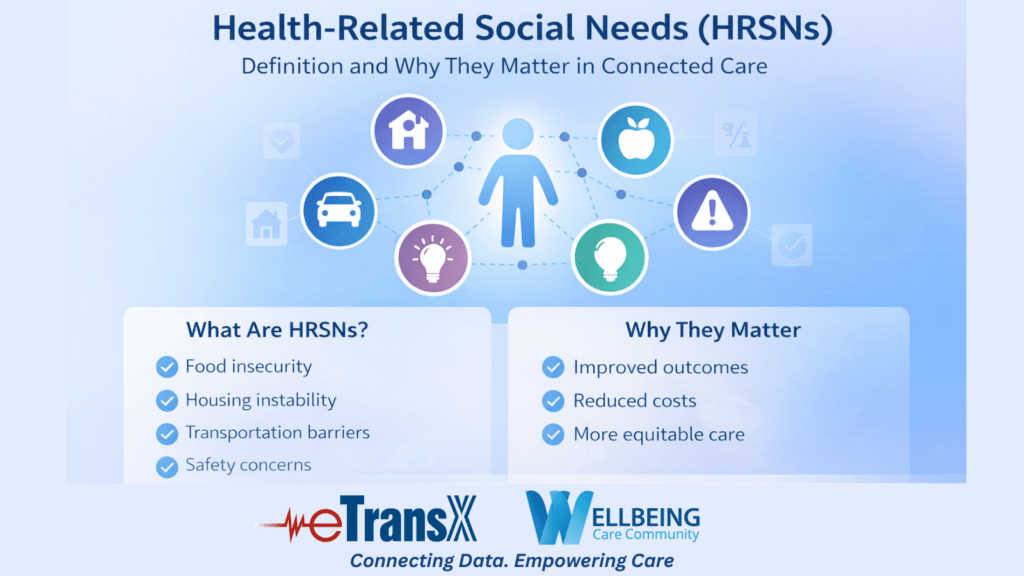
Total personal wellbeing extends far beyond clinical settings. To truly improve outcomes, organizations must also understand and address the non-medical factors that influence health. This is where Health-Related Social Needs (HRSNs) play a critical role.
What Are Health-Related Social Needs (HRSNs)?
Health-Related Social Needs (HRSNs) are individual-level social and economic challenges that directly impact a person’s health, well-being, and ability to access care.
Unlike broader population-level concepts, HRSNs focus on specific needs experienced by individuals, making them actionable within care delivery systems.
Common examples include:
- Food insecurity
- Housing instability
- Lack of reliable transportation
- Utility assistance needs
- Interpersonal safety concerns
These needs often act as barriers to receiving timely and effective healthcare.
Why HRSNs Matter in Healthcare
Clinical care alone accounts for only a small portion of total health outcomes. When social needs go unmet, patients are more likely to experience:
- Increased hospitalizations and readmissions
- Poor medication adherence
- Delayed or missed appointments
- Worsening chronic conditions
Addressing HRSNs allows healthcare organizations to shift from reactive treatment to proactive, whole-person care, ultimately improving both outcomes and cost efficiency.
HRSNs vs. Social Determinants of Health (SDOH) – Also known as Social Drivers of Health
While often used interchangeably, HRSNs and Social Determinants of Health (SDOH) are distinct:
- SDOH refers to broad, population-level conditions such as education, income, and neighborhood environment.
- HRSNs are individual-specific needs that require direct intervention.
In simple terms:
SDOH explains the environment people live in, while HRSNs identify the immediate needs individuals face.
Both need to be handled in the same system. WCC supports social drivers of health screening and referral coordination, so a population-level pattern and an individual’s immediate need can be acted on through the same workflow rather than two separate ones.
The Need for a Connected Approach
Identifying HRSNs is only the first step. The real challenge lies in acting on that information effectively.
Healthcare and community systems often operate in silos, making it difficult to:
- Share data across platforms
- Coordinate care between providers and community organizations
- See and confirm whether needs are actually resolved
Without unified cross-sector partnerships, even correctly identified personal needs can remain unaddressed.
How eTransX Enables HRSN-Driven Care
1. Seamless Data Integration
With solutions like eTX HEMI, data from EHRs, labs, claims, and community systems can be unified, enabling a complete view of an individual’s needs.
2. Interoperability Across Systems
Real-time data exchange ensures that social needs information is accessible wherever care is delivered.
3. Community Collaboration
Through the Wellbeing Care Community (WCC), organizations can connect individuals to the right social services and track referrals effectively.
4. Personal Success Pathways
From screening to service delivery and outcome tracking, eTransX supports a closed-loop referral system and care pathways, ensuring accountability and measurable impact.
Challenges in Addressing HRSNs
- Fragmented data systems
- Limited interoperability
- Manual and inefficient referral processes
- Lack of visibility into outcomes
The Future of HRSNs in Healthcare
- Treating HRSNs as essential health data
- Enabling real-time interoperability
- Strengthening partnerships with community-based organizations
- Measuring outcomes beyond clinical metrics
Organizations that embrace this approach will be better positioned to deliver equitable, person-centered care.
Wellbeing Care Community – Uniting Traditional Healthcare and Efforts to Address HRSNs and SDOH
Health-Related Social Needs are not secondary to healthcare; they are fundamental to it. Addressing them requires more than awareness; it requires action powered by cross-sector connectivity and shared data.
By enabling seamless integration, real-time data exchange, and coordinated care, eTransX helps organizations move toward a future where every individual receives the support they need for a healthier, more stable life.
Improve Outcomes in Your Community
Ready to take a connected approach to addressing Health-Related Social Needs?
Explore how eTransX solutions can help you integrate data, streamline referrals, and improve outcomes across your care ecosystem.
Schedule a conversation with our team
Explore how eTransX solutions can help you integrate data, streamline referrals, and improve outcomes across your care ecosystem, starting with addressing social drivers of health in your community.